
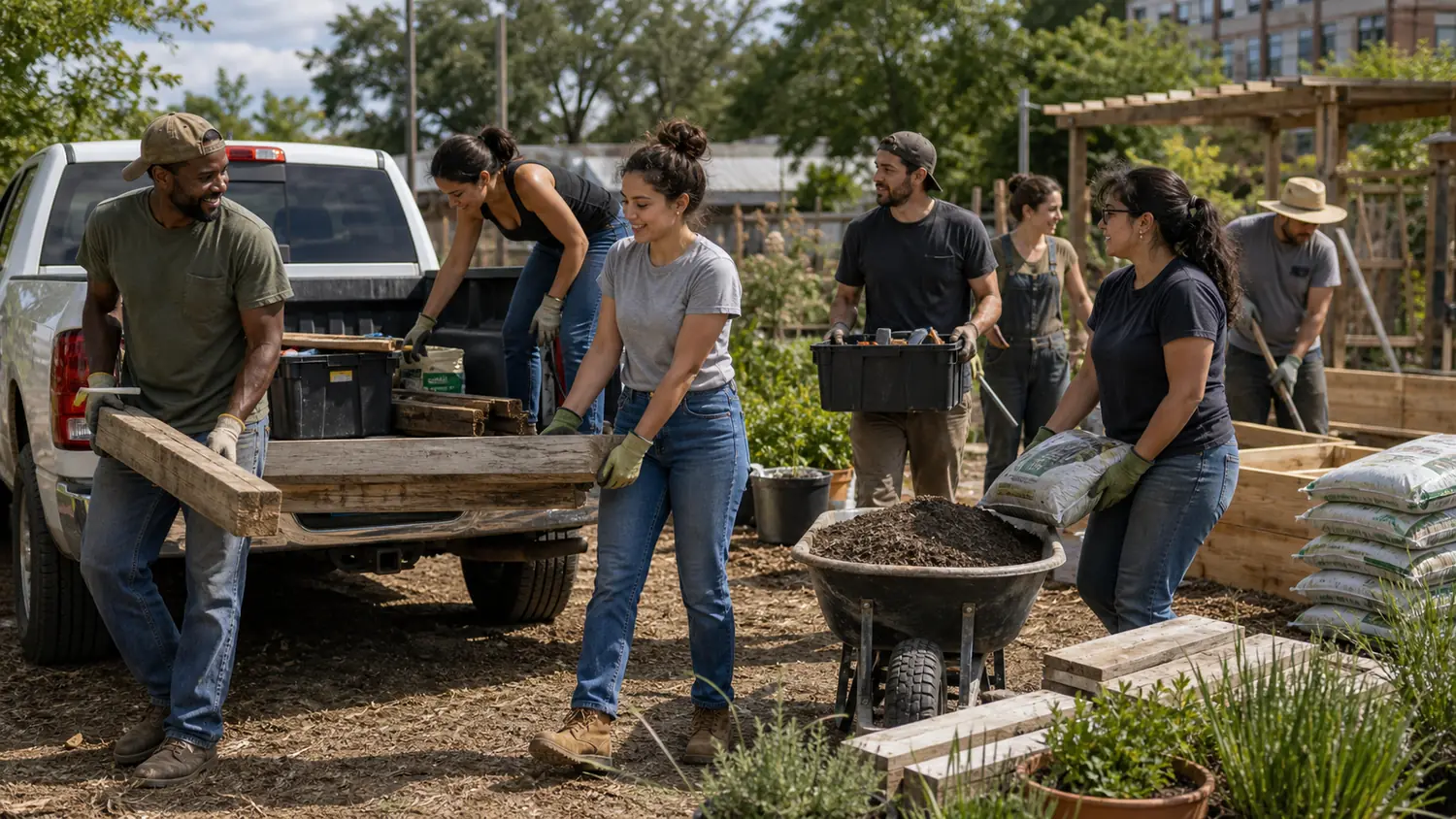
How Humans Become More Than Consumers
A researched guide to moving from consumption identity into repair, care, skill, stewardship, service, and community belonging.
Sections
Quick answer
Humans become more than consumers when they move from passive buying into active participation: repairing, growing, teaching, sharing, volunteering, stewarding land, caring for neighbors, and making useful things last. Research on social connection, volunteering, materialism, and nature connectedness points in the same direction: people need belonging, agency, purpose, and relationship more than endless acquisition.
Consumer culture trains people to ask the same question over and over: what can I buy to become the person I want to be?
That question is profitable, but it is too small for a human life.
Humans are not only buyers. We are builders, growers, repairers, teachers, neighbors, cooks, witnesses, mourners, hosts, protectors, and stewards. The problem is not that people consume. Every living body consumes. The problem is when consumption becomes the main way a person knows who they are.
Shared World’s work starts from a different question: what can I repair, grow, share, protect, or give?
Consumption is not the same as life
Modern life makes consumption feel like participation. Click, order, subscribe, upgrade, replace, repeat. It creates movement without relationship. It gives a person choices without asking whether those choices build capacity.
Buying a tool is not the same as knowing how to use it. Buying food is not the same as knowing how soil works. Donating an item is not the same as making sure it reaches a real need. Posting about a problem is not the same as showing up.
The first step is not guilt. Guilt burns fast and usually turns into avoidance.
The first step is agency.
Ask:
- What do I depend on that I do not understand?
- What do I throw away that someone could repair or use?
- What skill would make me more useful to my neighborhood?
- Who near me is already doing the work?
- What can I give besides money?
The research points away from isolation
The CDC describes social connection as the size, diversity, function, and quality of relationships. It links strong social bonds with longer, healthier lives, better stress management, and community resilience. That matters because consumer culture often isolates people while pretending to serve them.
Shopping can be done alone. Repair usually brings people together. Gardening brings people into weather, soil, food, insects, neighbors, and time. Volunteering places a person inside a web of need and response.
The research on volunteering is not simplistic, but it is consistent enough to matter. Reviews of volunteering and wellbeing often find links with social connection, sense of purpose, mental health, and sometimes physical health. The lesson is not that volunteering is magic. The lesson is that useful participation changes the human context.
People are not built to be only end users.
Materialism shrinks the field of attention
Materialism asks the self to locate meaning in acquisition, status, comparison, and external reward. That does not mean every purchase is bad. It means the center of gravity moves outside the person.
A PubMed-indexed experimental study on acts of kindness and materialism found a more complicated picture than a slogan would suggest. Practicing kindness did not simply erase materialism, but it was associated with less intention to shop impulsively, less focus on external aspirations, and more focus on internal aspirations. The study also points to a broader research base linking materialistic values and wellbeing.
That is useful because the alternative to consumer identity is not moral purity. It is attention training.
Where attention goes, life follows.
If attention goes to comparison, the self becomes a display case. If attention goes to repair, the self becomes capable. If attention goes to soil, the self becomes patient. If attention goes to service, the self becomes connected.
The five identities that replace the consumer
The repairer
The repairer refuses the idea that broken means finished. A repairer learns how things are made, where they fail, and how to extend their life.
This identity matters because waste is often a failure of imagination. EPA’s sustainable materials management framework looks at the full life cycle of materials, from extraction to use, reuse, maintenance, and end-of-life. Repair is one of the simplest ways a person can step back into that life cycle.
Start small:
- Patch clothing.
- Sharpen a tool.
- Fix a chair.
- Replace a cord.
- Clean and test donated equipment.
- Help run a repair table at a community event.
Repair turns consumption into relationship.
The grower
The grower learns that food is not a product first. Food is soil, water, seed, weather, labor, storage, and care.
Growing even a little food changes a person. A herb pot, a compost bin, a tomato plant, or a shared garden bed breaks the illusion that food appears by purchase alone. It also teaches limits. Plants do not care about branding. Soil does not respond to self-image.
EPA’s compost guidance names composting as a way to reduce trash, build healthy soil, improve water retention, and support resilience. That is a good model for becoming more than a consumer: take what was treated as waste and return it to life.
The steward
The steward asks what a place needs over time.
A steward does not treat land, tools, buildings, or organizations as disposable. Stewardship is slower than ownership. It includes maintenance, records, accountability, and restraint.
In community work, stewardship looks like:
- Keeping a tool library organized.
- Watering young trees through heat.
- Checking on elders after storms.
- Maintaining records of approved service hours.
- Writing down what worked after a volunteer day.
- Saying no to a donation that would become waste.
Stewardship is not glamorous. That is why it is trustworthy.
The teacher
A teacher multiplies usefulness.
Every community needs people who can show others how to compost, plant, cook, repair, document, lift safely, use a drill, read a label, prepare a bed, or write a clear project need.
Teaching also protects dignity. If one expert holds all knowledge, everyone else stays dependent. When skills spread, a community becomes less fragile.
The neighbor
The neighbor is the identity consumer culture most often erodes.
A consumer can be anonymous. A neighbor cannot. A neighbor notices the shared fence, the empty fridge, the broken ramp, the new baby, the lonely elder, the storm damage, the unused tools, the garden that needs hands.
CDC’s social connection guidance names public places, neighborhoods, schools, workplaces, parks, and places of worship as community settings where supportive connection can grow. Shared World adds another setting: the workday. People bond differently when they are doing useful work side by side.
Replace transactions with loops
The consumer model is linear:
Buy. Use. Discard. Repeat.
A living community uses loops:
Food scraps become compost. Compost feeds soil. Soil grows food. Surplus feeds neighbors. Neighbors volunteer. Volunteers learn skills. Skills repair tools. Tools build gardens. Gardens create more compost.
This is not poetry. It is systems design.
When a person joins a loop, the person stops being only a sink for products. They become a node where value can pass through, change form, and keep moving.
A 30-day practice plan
Do not try to change your whole life through one dramatic vow. Start with one month of concrete practice.
Week 1: Audit
Track what you throw away, what you buy without thinking, and what you depend on daily. Do not shame yourself. Just observe.
Week 2: Repair
Choose one item to repair, clean, mend, sharpen, or route to someone who can use it. Learn the story of the object.
Week 3: Grow or compost
Start a small compost habit, plant food, join a community garden shift, or help move compost to a site that needs soil.
Week 4: Serve
Volunteer one shift. It can be sorting, planting, hauling, documenting, teaching, or calling people. Make it physical enough that your body knows you participated.
At the end of the month, ask what changed. Did you feel more capable? Did you meet someone? Did something avoid the trash? Did one need get met?
The deeper freedom
The point is not to become anti-modern. Shared World uses websites, records, logistics, data, forms, and tools. Technology is not the enemy. Passive consumption is the trap.
The deeper freedom is to become harder to reduce.
A person who can grow food, repair tools, share resources, keep records, organize volunteers, care for neighbors, and protect land is more than a target market. That person becomes part of the living capacity of a place.
That is the work.
Sources and further reading
Common questions
Does becoming more than a consumer mean buying nothing?
No. People still need tools, food, shelter, medicine, clothing, and technology. The shift is from identity through buying to agency through making, repairing, sharing, serving, and choosing carefully.
What is the first practical step away from consumer identity?
Pick one daily need and become useful inside it. Cook one staple meal, repair one item, grow one herb, share one tool, volunteer one shift, or document one resource that can help someone else.
Why does Shared World talk about this?
Shared World exists to turn people from isolated users of systems into contributors to local life: volunteers, growers, repairers, donors, teachers, stewards, and neighbors.
Related guides
Put this into work
Bring a project need, offer materials, or join a local service shift.